In just a few days, the interstellar object 3I/ATLAS will make its closest approach to Earth — coming within 167 million miles. While that distance sounds huge to us, in cosmic terms, it’s a mere wave from a visitor passing through our solar neighborhood. Scientists and astronomers are buzzing with excitement, as this rare interstellar traveler gives humanity a fleeting but valuable chance to study an object from another star system.
Unlike most comets that orbit the Sun in predictable patterns, 3I/ATLAS has come from interstellar space, likely traveling for millions of years before reaching our solar system. And it’s already proving to be anything but ordinary.

Read more: Scientists Just Measured the Shortest Unit of Time Ever — a Zeptosecond
What Makes 3I/ATLAS So Unusual?
For months, astronomers have been tracking 3I/ATLAS as it races through our solar system. At first glance, it appears similar to a comet — a mixture of ice, dust, and rock. But its behavior is defying expectations.
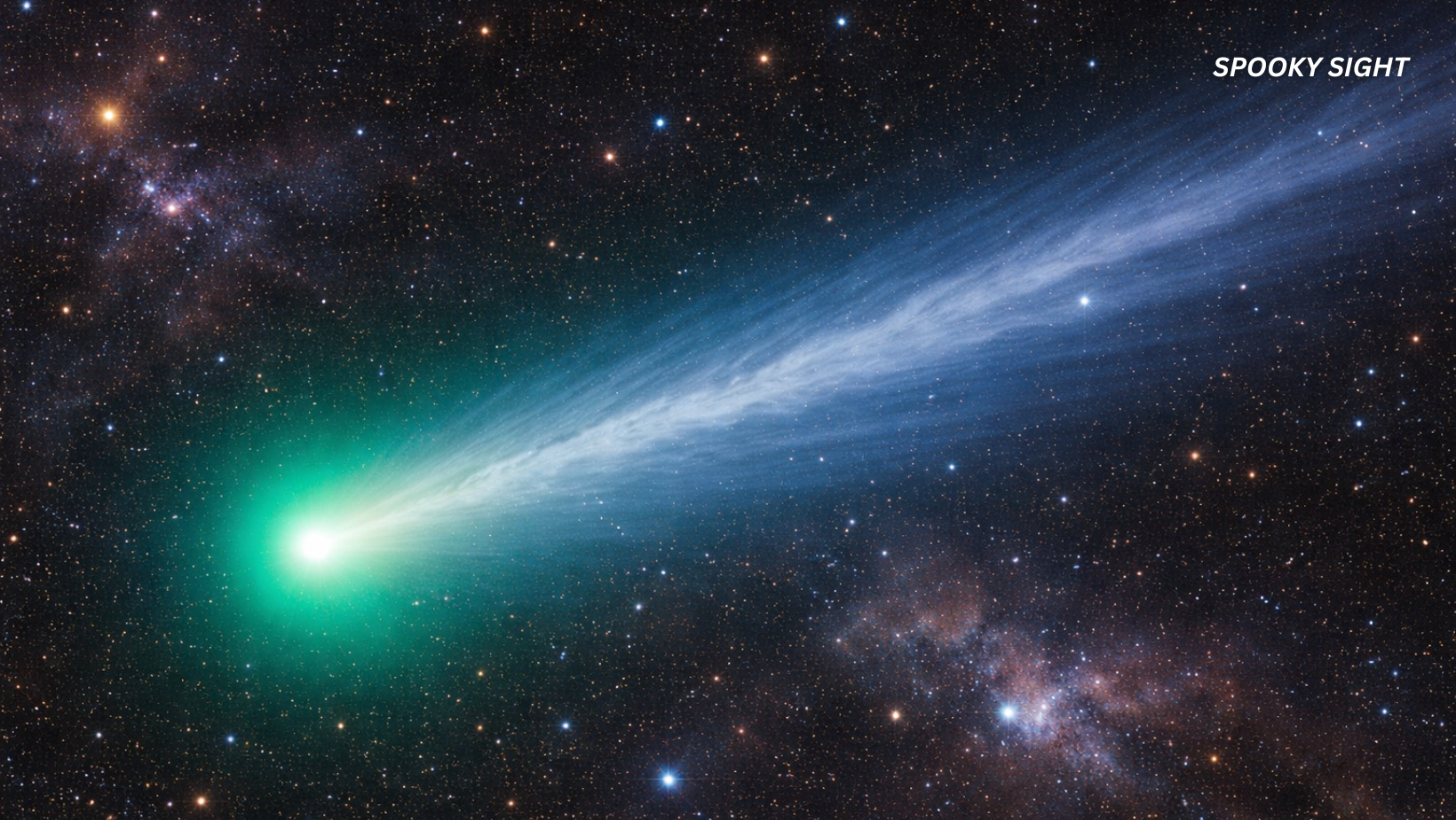
The first clue came from NASA’s Hubble Space Telescope, which captured images of 3I/ATLAS on July 21. Observers noticed a surprising feature: a second tail pointing directly toward the Sun, instead of streaming away as is typical for comets. This type of tail, known as an “anti-tail,” is unusual and rare.
Normally, a comet’s tail is shaped by two main forces: the solar wind, which is a stream of charged particles flowing from the Sun, and solar radiation, which pushes dust particles away. That’s why comet tails almost always point away from the Sun. So, seeing one pointing sunward immediately caught scientists’ attention.
The Mystery of the Anti-Tail
Harvard astronomer Avi Loeb has offered one explanation for this strange tail. He suggests that the side of 3I/ATLAS facing the Sun may be losing material at a faster rate, causing larger fragments to break off. Unlike tiny dust particles, these heavier chunks are less affected by solar forces, allowing them to accumulate on the Sun-facing side and form a visible anti-tail.
Even more than a month after 3I/ATLAS passed closest to the Sun — an event called perihelion — the anti-tail remains prominent. Images taken by the Teerasak Thaluang telescope in Rayong, Thailand, show a bright tail pointing toward the Sun, confirming that this feature isn’t a trick of perspective but a real, physical phenomenon.
Could It Be Alien?
Loeb has also raised a more speculative possibility: that 3I/ATLAS might not be a natural comet at all. In a paper not yet peer-reviewed, he suggested that the anti-tail could consist of a “swarm of objects” trailing the comet due to unusual, non-gravitational accelerations. While this hints at the tantalizing idea of an alien spacecraft, Loeb stresses that it’s only one hypothesis among several.
It’s a bold claim that has attracted both intrigue and skepticism in the scientific community.
Skepticism From Other Experts
Many astronomers remain unconvinced by the alien hypothesis. UCLA comet expert David Jewitt explained that the dual tails can be explained by normal comet behavior. “The day side of the nucleus is hot, so it naturally ejects dust particles toward the Sun,” he said. “This fits with what we know about comets — nothing shocking here.”
Similarly, Pennsylvania State University astronomer Jason Wright pointed out that sunward tails have been observed in other comets. These occur when larger dust grains aren’t easily pushed away by solar wind. Even the European Space Agency has suggested that the secondary tail is likely just a typical “dust tail,” made up of small solid particles behaving predictably around the Sun.
Read more: Scientists Confirm Existence of Massive Underground Tunnels on Venus
How Comet Tails Work
To understand why 3I/ATLAS is so fascinating, it helps to know a bit about comet tails. Comets usually have two types of tails:
- Ion tails: Formed from gas molecules ionized by solar radiation. These are straight and always point directly away from the Sun.
- Dust tails: Formed from tiny solid particles released from the comet’s surface. These curves slightly because dust particles are heavier than gas molecules and move more slowly under the influence of the Sun’s gravity.
What makes 3I/ATLAS special is the presence of a third, sunward-pointing tail — the anti-tail — which is less common and often linked to the behavior of larger fragments or unusual ice particles that evaporate differently from standard cometary material.
Alternative Explanations for the Anti-Tail
Loeb continues to explore multiple possibilities for the anti-tail. In other research papers, he proposed that sunlight scattering off ice fragments shed from the Sun-facing side could create this unusual feature. These tiny ice particles evaporate before forming a conventional comet tail, making them appear sunward in photographs.
In short, while the anti-tail is puzzling, it doesn’t necessarily indicate anything extraterrestrial. It is, however, a fascinating demonstration of the complex dynamics at play in comets and interstellar visitors.
Why Astronomers Are Watching Closely
The excitement around 3I/ATLAS isn’t just about curiosity. Every anomaly like this gives scientists a chance to learn more about comet physics, the behavior of dust and ice in space, and the processes that shape interstellar objects. Even small surprises can reveal new insights about our cosmic neighborhood and the broader universe.
Loeb emphasizes, “By recognizing anomalies, we can learn something new. By ignoring them, we remain ignorant.” Studying 3I/ATLAS as it passes by Earth may not answer all questions, but it’s a rare opportunity to peek behind the veil of the cosmos.
The Significance of Interstellar Visitors
3I/ATLAS isn’t the first interstellar object to visit our solar system, but every new arrival teaches us something unique. Interstellar objects come from other star systems, carrying clues about conditions far beyond our Sun. Unlike most comets, which originate from the Kuiper Belt or Oort Cloud within our solar system, interstellar visitors can have unusual trajectories, compositions, and behaviors.
Each observation, photograph, and measurement helps scientists refine their understanding of how objects behave in space, the diversity of planetary systems, and even the potential for materials or structures unknown in our local neighborhood.
Read more: Archaeologists Discover Mysterious Amazon Spheres Filled With Bones That Don’t Belong Together
A Cosmic Visitor to Remember
Whether 3I/ATLAS turns out to be an ordinary comet with unusual tails or something more extraordinary, its journey past Earth is a reminder of the vast and mysterious universe we inhabit. Scientists, astronomers, and space enthusiasts around the world will continue to watch, photograph, and analyze every detail, hoping that this sunward-pointing visitor has more secrets to reveal.
In the end, 3I/ATLAS embodies the thrill of discovery. It reminds us that space is full of surprises, and every new object can challenge what we think we know about the cosmos.
Featured image: GPT/5.1 Recreation for original illustration.
Friendly Note: Spookysight.com shares general information for curious minds. Please fact-check all claims. 🌱