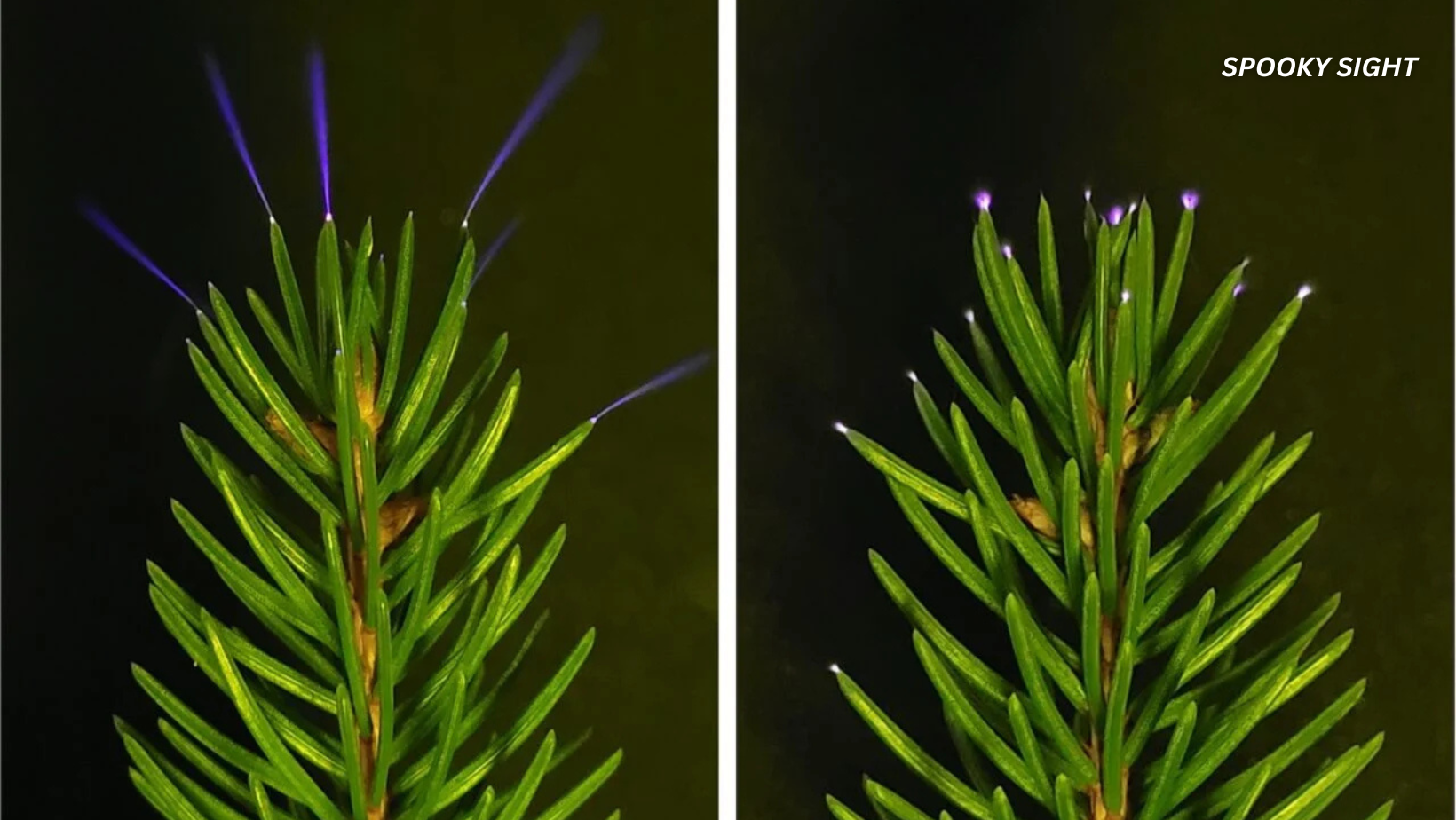
Pennsylvania State University researchers have confirmed something that sounds almost magical but is rooted in atmospheric science. During powerful thunderstorms, trees can produce faint ultraviolet flashes at the tips of their leaves. These tiny bursts of light are invisible to human eyes, yet they are very real.
In the summer of 2024, a small research team decided to chase storms along the East Coast of the United States. Instead of hunting dramatic lightning bolts, they were searching for something far more subtle. Their goal was to capture the first real world footage of what scientists call corona discharges on trees.
A Storm Chase With an Unusual Goal
The team traveled in a Toyota Sienna minivan that had been transformed into a rolling weather lab. During one intense storm in Pembroke, North Carolina, they focused their cameras on three branches of a sweetgum tree. Rain fell. Thunder echoed overhead. Lightning cracked in the distance.
Later, when they reviewed the footage, they saw what scientists had only theorized about for decades. Brief, colorful glows flickered at the tips of leaves. These flashes appeared for only a few seconds at a time. Sometimes they seemed to jump from one leaf tip to another.
It was the first time corona discharges had been documented on trees in the wild during an actual thunderstorm.

Related article: Humans Gave Up Fur for This Evolutionary Advantage, Biologist Says
What Are Corona Discharges?
A corona discharge is a small electrical release that happens when the air around an object becomes strongly charged. Thunderstorms create powerful electric fields between clouds and the ground. When this electric tension builds, energy looks for a path to travel.
Trees are perfect candidates for this interaction. They are tall. They are filled with moisture and minerals that help conduct electricity. Their branches and leaves reach upward, making them some of the highest points on the landscape.
When the electric field overhead becomes strong enough, opposite charges build up on the ground and on objects connected to it, including trees. The energy gathers at the sharpest points, which are often the tips of leaves and needles. At those points, small discharges can occur, releasing faint ultraviolet light.
In laboratory experiments, corona discharges have been observed for many years. If the room is completely dark, researchers can sometimes see a soft blue glow. But capturing that same effect outside, during a real storm, had never been achieved until now.
Turning a Minivan Into a Mobile Lab
To make this discovery possible, the research team equipped their vehicle with specialized tools. The van carried a weather station to measure atmospheric conditions, an electric field detector to track changes in charge, and a laser rangefinder to measure distances. A periscope mounted on the roof directed light into an ultraviolet sensitive camera.
The camera was essential because the flashes produced by corona discharges are mostly in the ultraviolet range. Human eyes cannot detect ultraviolet light, so without special equipment, the treetops would look completely normal.
One of the more memorable parts of the project involved cutting a large hole into the roof of the van to install the periscope. It may not have helped the resale value of the vehicle, but it made the science possible.
Capturing the First Evidence
The results were striking. During a single 90 minute storm, the team recorded 41 separate corona events on leaf tips. Each glow lasted about three seconds. Some appeared to move from one leaf to another as the electric field shifted.
Over the course of that summer, the scientists chased four additional storms between Florida and Pennsylvania. They observed similar ultraviolet flashes on different types of trees, including a loblolly pine. No matter the species or the exact strength of the storm, the discharges behaved in much the same way.
The findings were later published in the journal Geophysical Research Letters, providing formal scientific documentation of corona discharges on trees during thunderstorms.
Related article: Moss Has Just Survived a Full Year Outside the International Space Station
Why This Discovery Matters
For nearly a century, scientists suspected that weak electrical glows might form at treetops during storms. Laboratory experiments showed it was possible. The missing piece was real world confirmation.
Now that researchers have captured clear evidence, it opens the door to deeper questions about how thunderstorms interact with landscapes. Corona discharges may be more common than anyone realized. The study suggests that during a typical thunderstorm, tens or even hundreds of leaves on a single treetop could be producing these faint ultraviolet sparks at the same time.
Although the flashes are too faint to see without special cameras, imagining the scene is fascinating. If human eyes could detect ultraviolet light, treetops during a thunderstorm might resemble a shimmering canopy filled with flickering lights.
Are These Sparks Dangerous?
The ultraviolet flashes themselves are not something a person would notice or feel. They are brief and extremely small compared to a lightning strike. The main risk during a thunderstorm remains lightning, which can travel through tall objects like trees.
The corona discharges are more like gentle electrical whispers compared to the roar of a lightning bolt. They reveal how alive the atmosphere becomes during a storm and how trees actively respond to shifting electric forces around them.

Related article: 3I/Atlas Shows A Strange Protrusion As It Speeds Toward Earth
A New Way to See Storms
This discovery adds a surprising layer to our understanding of thunderstorms. Most people think of storms in terms of rain, thunder, and lightning. Now scientists know that treetops are also part of the story, responding with their own faint bursts of ultraviolet energy.
It is a reminder that nature often holds subtle phenomena hidden just beyond human senses. With the right tools and a bit of curiosity, even something as familiar as a tree in a storm can reveal a new secret.
During the next thunderstorm, the treetops outside may appear still and dark. Yet above those leaves, invisible sparks could be flickering in response to the electric sky. Science has finally confirmed that these ultraviolet sparkles are not just theory. They are a real and remarkable part of the natural world.
Featured image: William Brune/Coronae glow on the tips of spruce needles using charged metal plates in a laboratory.
Friendly Note: Spookysight.com shares general information for curious minds. Please fact-check all claims. 🌱