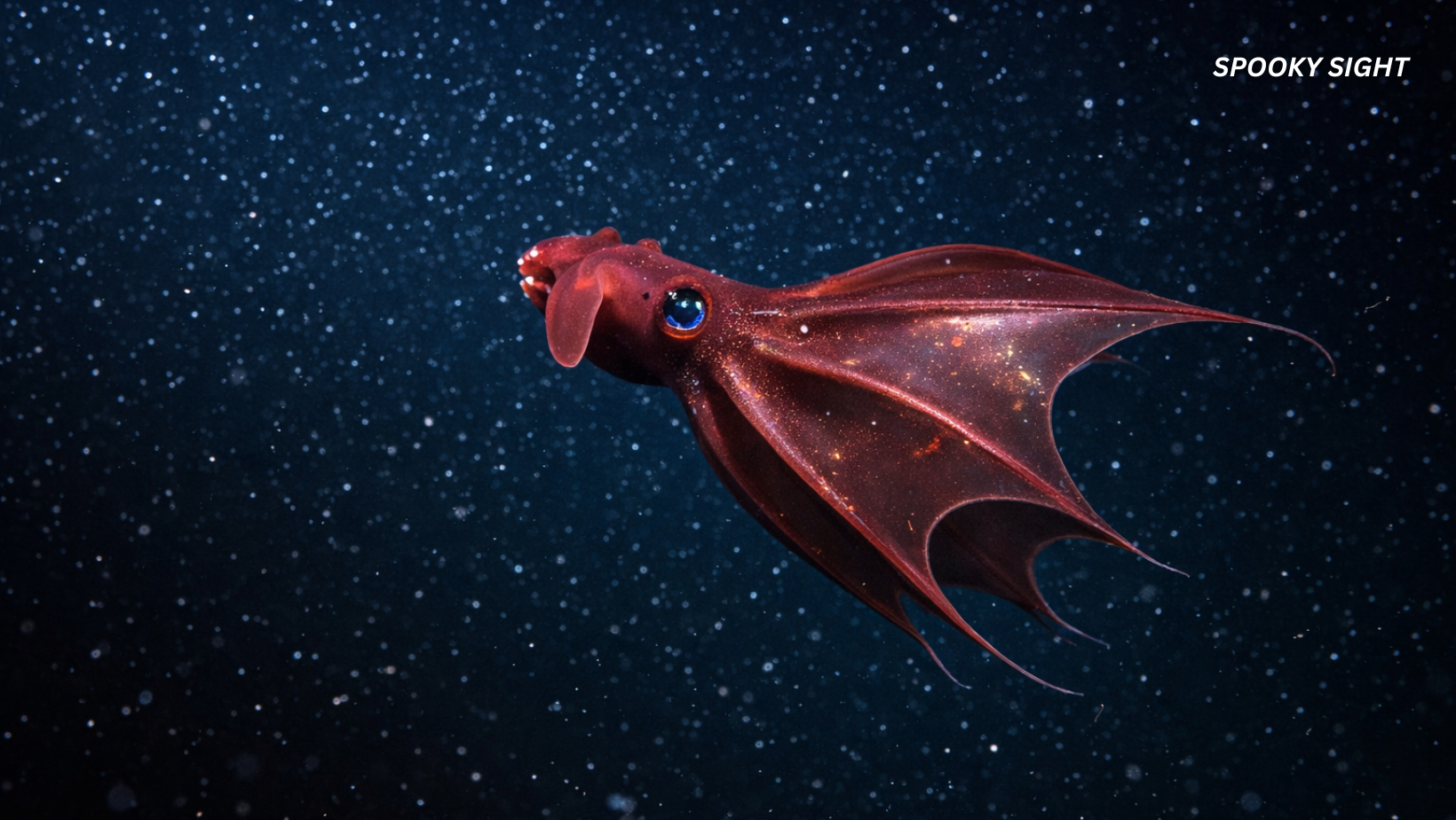
The vampire squid has long captured imaginations with its eerie name and otherworldly appearance. Far from being a creature of horror, the real fascination lies in its DNA—a genetic blueprint that has remained virtually unchanged for millions of years. This deep-sea dweller belongs to a group called vampyropods, a lineage that has existed for at least 165 million years. While it shares a family resemblance with octopuses—sporting eight arms and lacking the long tentacles of squids—its genetic code surprisingly overlaps with squids and cuttlefish, distant cousins that branched off long ago in evolutionary history.
For decades, this unusual mix of traits has puzzled scientists. How could a creature that looks so much like an octopus carry genetic hallmarks of squids? Thanks to a groundbreaking international study led by the University of Vienna, researchers have now sequenced the vampire squid’s genome, uncovering DNA structures that act like time capsules from the depths of evolutionary history.
A Genome From the Depths
The vampire squid’s genome is astonishingly large, with over 11 billion base pairs—the letters that make up its DNA. To put this in perspective, the common squid Doryteuthis pealeii has a genome of just 4.4 billion base pairs, and the everyday octopus Octopus vulgaris comes in at only 2.7 billion. Imagine comparing a thick encyclopedia to a thin pamphlet; that’s the scale difference.
Despite its enormous size, the genome remains remarkably stable. More than 60 percent of it consists of repeating sequences, yet it shows far less chaotic rearrangement than seen in modern octopuses. Because of this stability, scientists have nicknamed it a “genomic living fossil.” Its chromosomes preserve ancient patterns that likely existed before the major branches of cephalopods—like octopuses and squids—split apart.
“This genome is like a time capsule,” says Oleg Simakov, one of the study’s lead authors. “The vampire squid sits right at the interface between octopuses and squids, helping us fill in a big gap in evolutionary history.”

Read more: Scientists Just Measured the Shortest Unit of Time Ever — a Zeptosecond
The Deep-Sea Lifestyle and Survival
Vampire squids live in one of the most extreme environments on Earth: the oxygen minimum zone. Found at depths between 2,000 and 3,000 feet, these waters are low in oxygen and near freezing in temperature. Despite these harsh conditions, the vampire squid thrives, using minimal energy to drift through the dark, open ocean. Unlike many of its cephalopod cousins, it doesn’t actively hunt large prey. Instead, it feeds on marine detritus, capturing “marine snow”—tiny bits of organic matter that drift down from the surface—with delicate filaments.
This unusual lifestyle may help explain why its genome has remained so stable. Unlike octopuses that adapt rapidly to varied coastal environments, the vampire squid’s deep-sea habitat has remained relatively constant for millions of years. Its DNA reflects this long-term stability, preserving genetic patterns that vanished in other lineages.
How Octopus Chromosomes Reshaped Evolution
To understand the vampire squid’s uniqueness, the researchers also studied the genome of the pelagic octopus Argonauta hians. Comparing genomes across cephalopods revealed a striking difference: octopus chromosomes have been shuffled and fused over time, creating entirely new genetic combinations. This process, called “fusion-with-mixing,” has produced new regulatory regions that may have influenced the development of key traits in octopuses, such as their remarkable intelligence, complex nervous systems, and the ability to manipulate objects with precision.
The vampire squid, on the other hand, has retained much of its original chromosomal layout, resembling that of squids and cuttlefish. Its DNA tells the story of a lineage that split off before these major rearrangements occurred, offering the strongest evidence yet that octopuses descended from squid-like ancestors, not the other way around.
A Living Link to Ancient Seas
The vampire squid occupies a unique spot in the evolutionary tree. It is the last surviving member of vampyropods, a group that once thrived in oceans but mostly disappeared after the Cretaceous period, around 66 million years ago. Its survival and preserved genome provide scientists with a rare glimpse into stages of evolution that no longer exist in other species.
Because its chromosomes have remained largely unchanged, the vampire squid acts as a “Rosetta Stone” for understanding cephalopod evolution. Researchers can now study how traits like arm specialization, swimming mechanics, and shell loss developed—not through new genes, but by rearranging the existing genetic blueprint. This approach gives scientists a clearer picture of the evolutionary steps that led to the diverse range of squids, cuttlefish, and octopuses that dominate our oceans today.
“Although it is classified as an octopus, the vampire squid retains a genetic heritage that predates both octopuses and squids,” explains biologist Emese Tóth from the University of Vienna. Its preserved DNA makes it an invaluable model for studying evolution.
Fun Facts About the Vampire Squid
- It glows in the dark: Like many deep-sea creatures, the vampire squid produces light through bioluminescence. It can emit blue and red light, which it uses to confuse predators and communicate in the darkness.
- It doesn’t need to eat much: Because of its low-energy lifestyle, it can survive for months on minimal food, a rare ability among active predators.
- It has a cloak: Its webbed arms can fold around its body like a cloak, giving it a dramatic, cape-like appearance—hence the name “vampire.”
These quirks not only make the vampire squid a fascinating subject for marine enthusiasts but also highlight how evolution shapes organisms to survive extreme habitats.
Why This Discovery Matters
The vampire squid is one of the rarest and most elusive creatures of the deep, captivating scientists and ocean enthusiasts alike with its eerie appearance. Now, with its genome sequenced, researchers have something even more extraordinary: a direct link to an ancient world that shaped the cephalopods we see today.
By unlocking its DNA, scientists are solving a long-standing evolutionary puzzle, revealing that many modern octopus traits likely arose not from new genes but from the rearrangement of ancient genetic material. This discovery sheds light on how evolution can take different paths, leading to astonishing diversity even among closely related species.
Looking Ahead
The sequenced genome opens new doors for research. Scientists can now investigate how cephalopods developed advanced nervous systems, complex behaviors, and unique adaptations to the ocean environment. For example, studying the vampire squid’s preserved genetic patterns may help explain how deep-sea animals survive in low oxygen conditions—knowledge that could even inform human medicine in the future.
Moreover, the vampire squid serves as a reminder that the ocean is full of secrets yet to be discovered. Each deep-sea expedition can reveal creatures with ancient DNA, new behaviors, and evolutionary stories that challenge our understanding of life on Earth.

Read more: Scientists Confirm Existence of Massive Underground Tunnels on Venus
A Window Into the Past
From its eight arms to its bioluminescent glow and colossal genome, the vampire squid is far more than a deep-sea oddity. It is a living time capsule, offering a rare glimpse into evolutionary history and the genetic roots of modern cephalopods. Its genome bridges the gap between squids and octopuses, providing a clear window into how these remarkable animals evolved over millions of years.
For scientists, enthusiasts, and anyone fascinated by the mysteries of the ocean, the vampire squid stands as a testament to the enduring power of evolution and the wonders still lurking in the depths. While it may not be a blood-sucking monster of legend, its DNA is nothing short of extraordinary—a preserved record of life’s journey that has quietly survived in the darkness for hundreds of millions of years.
Featured image: Freepik.
Friendly Note: Spookysight.com shares general information for curious minds. Please fact-check all claims. 🌱