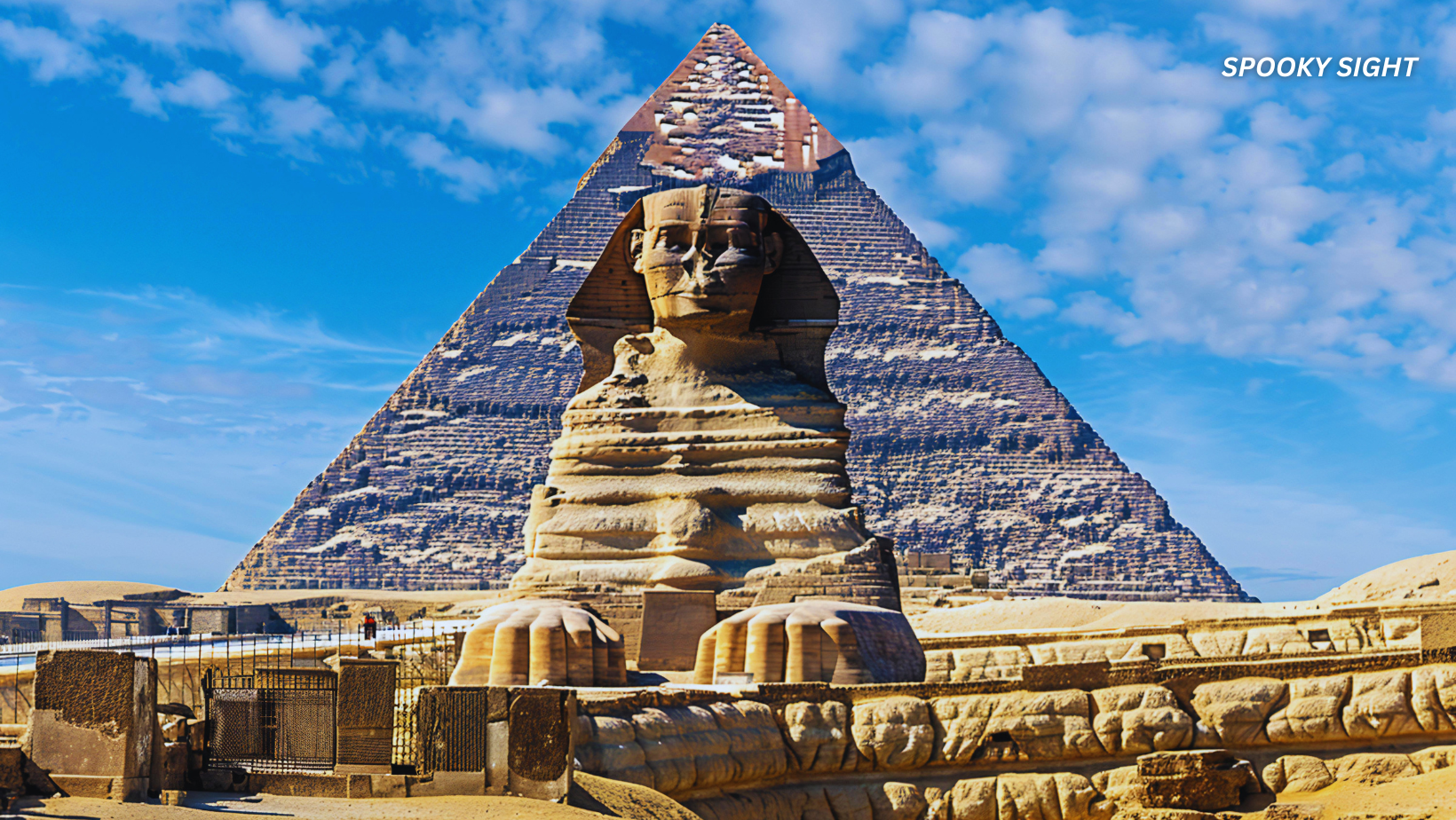
The Pyramids of Giza have long been seen as one of humanity’s greatest achievements. For centuries, they have stood in the Egyptian desert, surrounded by mystery, history, and countless theories. Now, a new idea is adding another layer of intrigue. Some researchers believe that what we see on the surface may only be part of a much larger story.
According to recent claims, there could be another Sphinx buried beneath the sand, along with a massive underground structure stretching beneath the famous plateau. While this idea is still being debated, it has sparked fresh curiosity about what may lie hidden below one of the world’s most studied archaeological sites.
A Discovery That Raises Big Questions
A group of researchers led by radar engineer Filippo Biondi has suggested that something large may exist beneath the Giza Plateau. Using satellite data and scanning technology, they identified unusual shapes and patterns under the ground that do not easily match natural formations.
Biondi explained that their measurements revealed something significant below the surface. The area in question lies near the well known landmarks of Giza, including the Great Pyramid, the Pyramid of Khafre, the Pyramid of Menkaure, and the Great Sphinx.
The idea is simple but bold. If the data is accurate, then the visible monuments might only represent a small portion of a much larger underground complex.

Read more: How Were the Pyramids Actually Built? Engineers Are Suggesting a New Theory
The Theory of a Hidden Twin Sphinx
One of the most fascinating parts of this claim involves the possibility of a second Sphinx. The Great Sphinx, with its lion’s body and human head, is one of the most recognizable statues in the world. It has stood guard over the Giza Plateau for thousands of years.
Biondi and his team believe there may be another similar structure buried beneath a nearby mound of sand. This mound appears in satellite images and stands out due to its size and shape. It is estimated to be around 108 feet tall.
The reasoning behind this idea comes from both modern data and ancient symbolism. Researchers noticed that certain lines connecting the pyramids and the known Sphinx also align with this hidden mound. The pattern appears intentional, almost like a geometric puzzle waiting to be solved.
Adding to the mystery, the first Sphinx itself sits slightly below ground level, as if it had once been covered by sand. This raises the possibility that another statue could remain buried nearby, still hidden after thousands of years.
Clues from Ancient Egyptian Art
Supporters of the theory also point to ancient Egyptian carvings for possible evidence. A stone slab known as the Dream Stele stands in front of the Great Sphinx. This monument was placed there during the reign of Pharaoh Thutmose IV.
The carvings on the stele include imagery that some interpret as showing two Sphinx figures rather than one. This detail has led to speculation that the idea of twin Sphinxes may have existed in ancient Egyptian culture.
The story connected to the stele is equally interesting. It describes how a young prince, later known as Thutmose IV, fell asleep near the Sphinx. In his dream, the statue appeared to him as a powerful being and promised him the throne if he cleared away the sand that covered it.
This story has often been seen as a political message meant to support his claim to power. However, some researchers now wonder if it might also hint at something more physical that once existed at the site.
Read more: Enigmatic 12-Sided Ancient Object Leaves Archaeologists Stumped
Signs of a Larger Underground Network
Beyond the idea of a second Sphinx, the scans have revealed what appear to be deeper structures below the surface. Researchers reported detecting vertical shafts and horizontal passages extending underground.
These features seem to form a network that spreads out beneath the plateau. Some of the tunnels appear to branch outward, suggesting a complex layout rather than random formations.
Interestingly, this underground pattern appears to mirror known structures around the visible Sphinx. The symmetry between what is above ground and what may lie below has led to the idea of a “megastructure” hidden beneath the desert.
If true, this could mean that ancient builders created a much larger system than what is currently visible. It would suggest that the Giza Plateau was designed with both surface and underground elements working together.
Not Everyone Is Convinced
Despite the excitement surrounding this theory, many experts remain skeptical. Archaeologists and Egyptologists have studied the Giza Plateau for decades using a wide range of methods, including excavations and advanced scanning technologies.
Zahi Hawass, a former Egyptian Minister of Antiquities, has dismissed similar claims in the past. He argues that extensive research has already been conducted in the area and that no evidence has been found to support the existence of hidden structures of this scale.
Skeptics also point out that natural geological formations can sometimes appear structured when viewed through certain types of scans. Without direct excavation, it is difficult to confirm whether these signals truly represent man made features.
Other Theories About a Second Sphinx
The idea of a second Sphinx is not entirely new. Egyptologist Bassam El Shammaa has suggested for years that there may have been another Sphinx in ancient times.
Some interpretations of Egyptian texts and myths describe events involving lightning or destruction connected to the Sphinx. One theory proposes that a second statue may have existed but was damaged or destroyed long ago.
There have also been claims from local officials suggesting the discovery of another large Sphinx like structure, although these reports have not been widely confirmed or accepted by the broader scientific community.
Why This Theory Matters
Even though the idea of a hidden megastructure remains unproven, it highlights something important about the Giza Plateau. Despite centuries of research, it still holds many unanswered questions.
New technologies, such as satellite imaging and ground scanning, are allowing researchers to explore the site in ways that were not possible in the past. These tools can reveal patterns and features that might otherwise remain invisible.
At the same time, it is essential to approach such claims with careful thinking. Extraordinary ideas require strong evidence, and scientific progress depends on testing and verification rather than speculation alone.
What Happens Next
Biondi and his team have stated that they are continuing to analyze their data. They are also seeking permission from Egyptian authorities to study the area more closely.
If future investigations confirm the presence of underground structures, it could reshape our understanding of ancient Egyptian engineering and design. It might reveal that the builders of the pyramids created a far more complex environment than previously believed.
For now, the theory remains an intriguing possibility rather than a confirmed discovery. It sits at the intersection of science, history, and imagination, reminding us that even the most familiar landmarks can still hold secrets beneath the surface.

Read more: Archeologists Find Ancient Child Remains Hidden Inside Maya Altar
A Mystery That Refuses to Fade
The Pyramids of Giza have always inspired wonder. From their precise construction to their cultural significance, they continue to capture the human imagination.
The suggestion of a second Sphinx and a hidden underground network adds another chapter to this ongoing story. Whether the theory proves true or not, it reflects a deeper truth about exploration. There is always more to discover, even in places that have been studied for generations.
For now, the sands of Giza keep their secrets. And perhaps, somewhere beneath them, there is still more waiting to be uncovered.
Featured image: Freepik.
Friendly Note: Spookysight.com shares general information for curious minds. Please fact-check all claims. 🌱