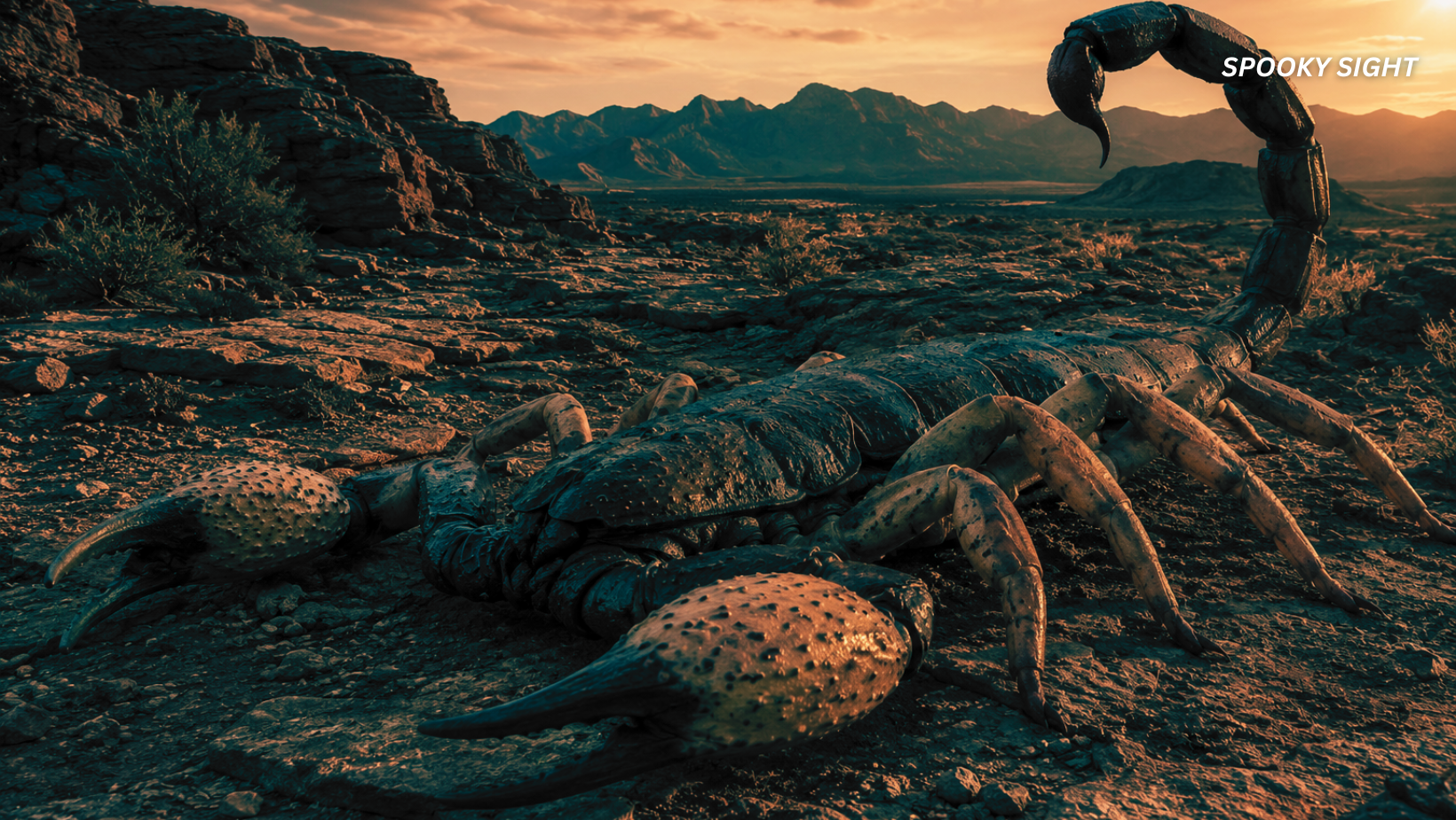
Picture a scorpion so enormous that it stretched more than three feet from head to tail. It crawled across damp landscapes filled with moss covered rocks and strange tree like plants, moving between land and water in a world that looked nothing like the one we know today. This remarkable creature lived around 415 million years ago in what is now Great Britain, and scientists believe it may have been the largest scorpion ever to walk the Earth.
Recent research has shed new light on this ancient giant after experts revisited fossil specimens that had been sitting in collections for more than a century. By combining old discoveries with newly examined fossils, researchers have been able to build a clearer picture of an animal that once puzzled scientists and challenged long held assumptions about prehistoric life.
A Fossil Mystery More Than a Century in the Making
The creature, known as Praearcturus gigas, was first identified during the nineteenth century. For decades, scientists struggled to determine exactly what kind of animal it was. Early researchers believed it might have been related to crustaceans such as lobsters, shrimp, or woodlice because some of its preserved features resembled those groups.
As paleontology advanced and more fossils were uncovered, opinions began to shift. By the 1980s, some experts suggested that the animal might actually belong to a completely different branch of life: the arachnids, the group that includes spiders, ticks, and scorpions.
The debate continued for years because the available fossils were incomplete. Like many ancient remains, the specimens were fragmented and lacked several key body parts that would have made identification easier.
Now, thanks to modern imaging technology and fresh analysis, researchers believe they have found stronger evidence supporting the idea that P. gigas was indeed a giant scorpion.

Bringing Ancient Fossils Back to Life
The research team examined eight fossils collected from several locations over many years. Some of these specimens had been preserved in London’s museum collections for more than one hundred years.
Using advanced CT scanning techniques, scientists were able to study details hidden inside the fossils without damaging them. These scans revealed structures that previous generations of researchers could not easily observe.
To help visualize the animal, scientists also collaborated with artists who created detailed reconstructions based on the fossil evidence. These illustrations allowed researchers to imagine how the creature may have looked and behaved in its ancient environment.
The result was a much more complete portrait of a giant predator that lived during one of the earliest chapters of life on land.
A Scorpion Unlike Any Alive Today
According to the study, Praearcturus gigas measured about one meter in length. That is slightly longer than three feet, making it roughly the size of a baseball bat.
Even by modern standards, that is an astonishing size for a scorpion.
Today’s largest scorpions generally reach only a few inches in length. In comparison, this prehistoric giant dwarfed nearly every living species. Some of its pincers alone may have measured around six inches long, making them several times larger than those of modern scorpions.
Its body was covered with rough bumps across the legs, claws, and head. These textured surfaces are considered a classic feature of scorpions and helped strengthen the argument that the animal belonged to that group.
Scientists also suspect that it possessed eyes positioned toward the front of its head, much like living scorpions. Although no eyes were preserved in the fossils, the arrangement of other anatomical features suggests a similar body plan.
The Clue That Changed Everything
One of the most important discoveries came from comparing P. gigas with another ancient species described in Canada in 2015.
That fossilized animal possessed a distinctive structure called a sternum, a plate located underneath the body between the bases of the legs. The sternum was long, triangular, and featured a groove running down the center.
Researchers noticed that the same unusual feature appeared in P. gigas.
Because the structures matched so closely, scientists concluded that the two animals were likely close relatives. This connection provided some of the strongest evidence yet that P. gigas should be classified as a scorpion rather than a crustacean.
Sometimes a single anatomical detail can transform scientists’ understanding of an extinct species, and in this case, the sternum became the crucial piece of the puzzle.
Read more: Here’s What It Means When You See a Cardinal
Living in a Very Different World
The giant scorpion inhabited Earth during the early Devonian Period, a time when life was still largely concentrated in the oceans.
Plants were only beginning to spread across land, and forests as we know them did not yet exist. The landscape was filled with primitive vegetation and shallow waterways that supported a wide range of unusual creatures.
What makes P. gigas particularly intriguing is that it appeared much earlier than many other giant arthropods.
Gigantic dragonfly relatives, massive millipedes, and other oversized invertebrates became common tens of millions of years later. Scientists often link their enormous size to increased oxygen levels in Earth’s atmosphere.
However, the world inhabited by P. gigas had significantly lower oxygen levels. This raises an important question: how did such a large arthropod evolve so early?
Researchers believe the answer may lie in its lifestyle.
Not Everyone Is Convinced
Although the new research presents compelling evidence, some experts remain cautious.
The main challenge is that the fossil record remains incomplete. Critical features normally associated with scorpions have not yet been discovered in the available specimens.
For example, researchers have not found evidence of the stinger that modern scorpions carry at the end of their tails. Another missing feature is a set of specialized sensory organs known as pectines, which are unique to scorpions.
Because these structures are absent from the fossils, some scientists argue that alternative interpretations should remain open.
Large pincers and certain body features can also appear in crustaceans, making classification difficult when only fragments are available.
Supporters of the scorpion theory respond that incomplete fossils are common in paleontology. Missing body parts do not necessarily indicate that those structures never existed. Instead, they may simply have failed to fossilize or remain undiscovered.
The debate highlights one of the most fascinating aspects of science: new discoveries often raise as many questions as they answer.

Read more: Second Sphinx Buried Under Sand May Point to Hidden Megastructure Beneath The Pyramids Of Giza
Why This Discovery Matters
The story of Praearcturus gigas demonstrates how scientific understanding evolves over time.
Fossils that have been studied for decades can reveal entirely new secrets when examined with fresh techniques and perspectives. What was once thought to be a crustacean is now being reconsidered as one of the earliest giant scorpions ever known.
The findings may also encourage scientists to revisit other ancient fossils from the same period. If P. gigas truly was a scorpion, researchers may uncover additional species that have been overlooked or misidentified.
Beyond that, the discovery could reshape scientific databases and influence how experts view the evolution of early arthropods. It offers a new glimpse into a time when life was experimenting with new ways of surviving and expanding across the planet.
More than 415 million years after it roamed ancient waterways, this giant predator continues to surprise scientists. Its story serves as a reminder that the fossil record is far from complete and that some of Earth’s most remarkable creatures may still be waiting to emerge from stone.